The short version
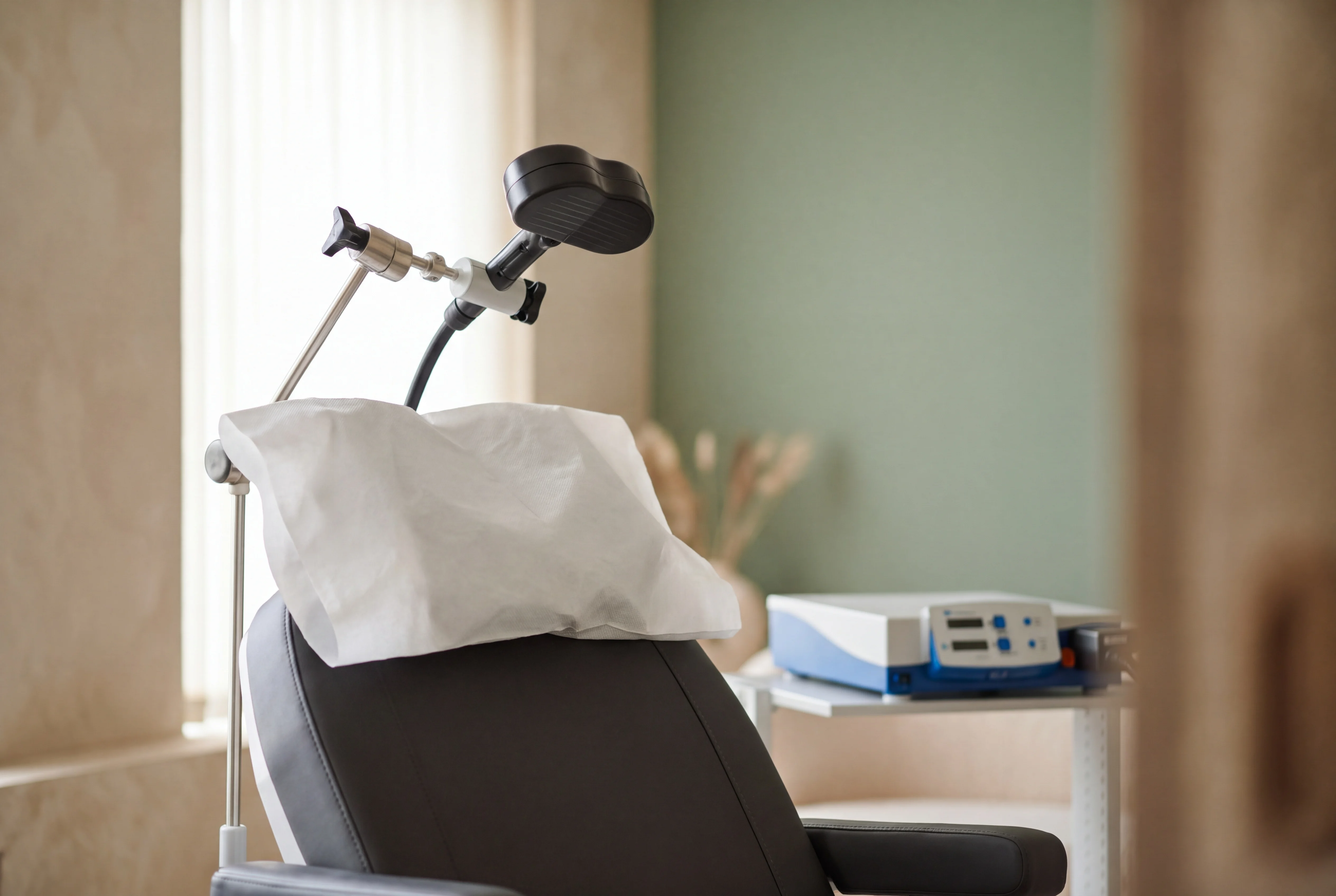
TMS stands for transcranial magnetic stimulation. “Transcranial” means across the skull, “magnetic” describes how the energy gets there, and “stimulation” is what it does once it arrives. A coil rests lightly against the scalp and produces short magnetic pulses, each lasting a fraction of a millisecond. The pulses pass through the skull without touching it and gently activate nerve cells in the part of the brain beneath the coil.
Nothing pierces the skin, no current is applied to the body and there is no anaesthesia or sedation. You are awake for the whole session, you can talk or rest, and you drive yourself home afterwards.
What it is used for
TMS is best established as a treatment for depression that has not responded adequately to medication. Medicare and DVA have funded it for treatment-resistant depression in adults since November 2021. It is also used for anxious depression on the same basis, and in some clinics for other conditions such as OCD, which we assess case by case. TMS is not a first-line treatment: it is for people who have already given standard treatment a fair try. See what we treat.
Where it came from
The technique was first demonstrated in 1985, when researchers showed that a magnetic pulse over the motor cortex could make a thumb twitch. Through the 1990s and 2000s it was studied as a treatment for depression, with regulatory clearance for that use following in the United States in 2008 and, over the years since, in Australia and many other countries. The equipment, protocols and safety guidelines in use today reflect several decades of published research and clinical experience.
What a course looks like
A session takes around twenty minutes. A standard course runs four to six weeks, with at least three sessions a week and most people attending five. The schedule is planned around work, family and travel. Every course is prescribed and overseen by a psychiatrist, delivered by trained TMS clinicians, and tracked with short standardised check-ins so your progress is measured rather than guessed.
For where the pulses go and what a session feels like, see how TMS works. For whether it might suit you, see is TMS for me.
General information only. Suitability is confirmed by a psychiatrist at assessment, and TMS does not replace the care of your GP or psychiatrist.