From magnet to nerve cell
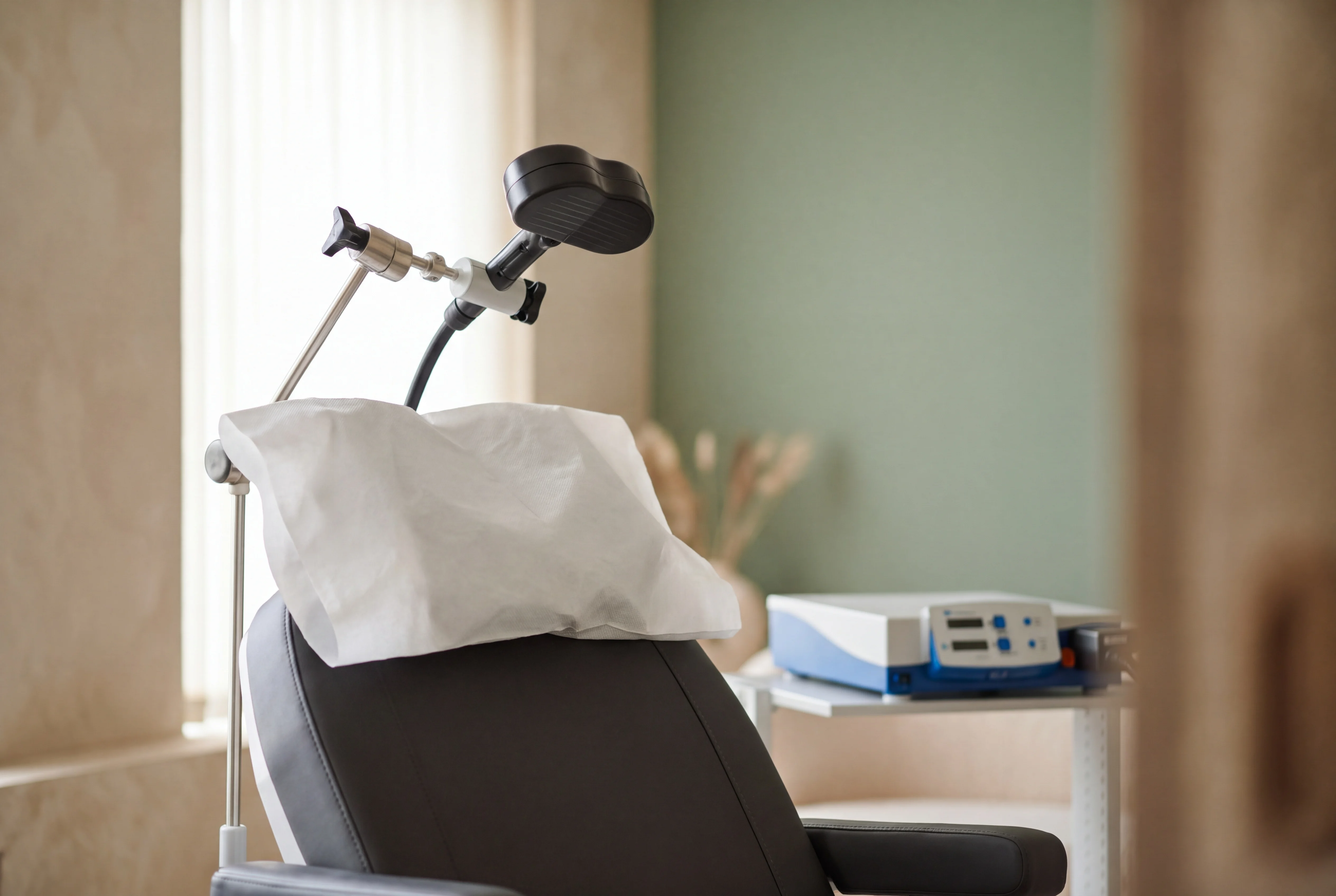
The coil contains a loop of wire. When a brief, strong electrical pulse runs through it, the loop produces a magnetic field that lasts for a fraction of a millisecond. Bone and skin do not block a magnetic field, so it passes straight through the scalp and skull. In the brain tissue a few centimetres beneath the coil, the changing field induces a small electrical current, and that current makes nerve cells fire. This is the same physics as a wireless phone charger, applied with far more precision.
The field falls away quickly with distance, which is what makes the stimulation focal: it reaches the outer layer of the brain under the coil and nothing deeper or further away.
Why the left prefrontal cortex
The left dorsolateral prefrontal cortex, just above and in front of the left temple, helps regulate mood and is consistently underactive in depression. It is also connected to deeper structures involved in emotion. Standard TMS stimulates this region, and the effect spreads along those connections into the wider mood circuit. You can see exactly where this is on our interactive diagram.
Why it takes a course
A single session changes activity in the circuit for a short time. Repeating the stimulation day after day encourages the brain to strengthen those pathways and hold the change, a process known as neuroplasticity: the same mechanism by which practice makes a skill stick. This is why treatment is given as a course of four to six weeks, and why people who respond often notice the shift in weeks two to four rather than after the first visit.
Dosed to you, not to an average
Everyone’s skull and brain sit slightly differently, so before your first treatment we measure your motor threshold: single pulses over the motor cortex until your thumb twitches. That reading calibrates the pulse strength for every session that follows, and the coil position is mapped from it. Nothing about your dose is guessed.
What a session feels like, and how we look after you through it, is on the safety page.
General information only. Suitability is confirmed by a psychiatrist at assessment, and TMS does not replace the care of your GP or psychiatrist.