Who it suits
Adults with major depression or anxious depression that has not responded adequately to at least two antidepressant medicines, who have no metal implants or devices in or near the head and no unmanaged seizure risk, and who can attend at least three sessions a week for four to six weeks. People who have responded to TMS before and relapsed can be prescribed a funded retreatment course at least four months after the first. OCD is assessed case by case. Under 18, treatment is privately funded on the same criteria after psychiatric assessment.
Suitability is always confirmed by a psychiatrist at assessment. See is TMS for me for the questions that assessment asks.
Before your first session
The psychiatrist reviews your history, confirms that TMS is appropriate, chooses the protocol and settles Medicare eligibility and cost in writing. You receive written information and a consent form, and there is time to ask questions. At your first visit your motor threshold is measured and the coil position is mapped to your own head; that map sets the dose for every session that follows.
During a session
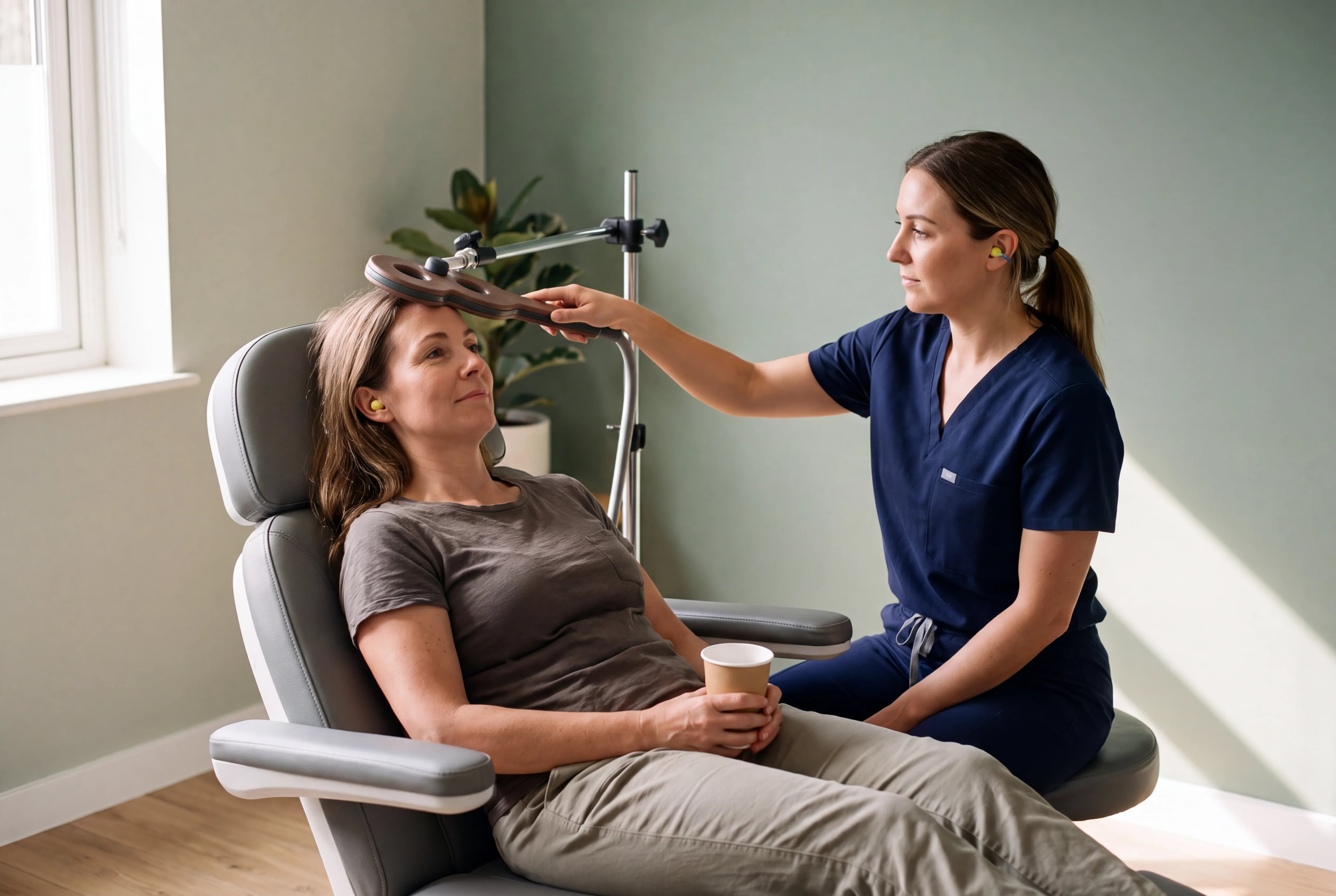
You sit in a reclining chair with hearing protection, the coil is positioned to your map, and the pulses run for around twenty minutes. Most people feel a steady tapping where the coil sits and hear a clicking sound; you can hear a soft approximation of it on the how TMS works page. You are awake, can talk or rest, a clinician is with you throughout, and the session can be paused at any time. There is nothing to change into and nothing to take.
After each session
Straight back to your day. There is no sedation and no recovery period, and you drive yourself home. Some people notice a mild headache early in the course, which typically passes within an hour and responds to ordinary pain relief, and the tapping sensation becomes much less noticeable as the first week goes on. Small adjustments early in the course often make the rest of it more comfortable, so tell your clinician if anything feels different. See the safety page.
Through the course and after
Short standardised check-ins run through the course so your clinician can see how you are responding and adjust against real change rather than impression; you can see the trend yourself. People who respond often notice the shift in weeks two to four. In published trials, roughly half to three in five people with treatment-resistant depression have a meaningful response and around a third reach remission; individual results vary, and your assessment is the honest guide to your own likelihood.
At the end of the course you return to your GP or psychiatrist with a written summary and a maintenance plan. If you responded and later relapse, a further funded course of up to 15 sessions can be prescribed at least four months after the initial course. Everything about cost is on the Medicare page.
General information only. Suitability is confirmed by a psychiatrist at assessment, and TMS does not replace the care of your GP or psychiatrist.